
Frequently Asked Questions
About Hallmark Group
Who is Hallmark Group?
Hallmark Group is New Zealand's largest New Zealand-owned door manufacturer. The company has been a trusted partner to New Zealand's architecture and construction industries for more than 35 years, producing doors from three factories in Auckland and Canterbury spanning 14,000 m2 of production space.
What does Hallmark Group make?
Hallmark Group manufactures interior and specialty doors in New Zealand, including:
-
Standard flush-panel doors
-
Fire doors
-
Acoustic doors
-
Healthcare and hospital doors
-
Mental health (anti-ligature) doors
-
Cavity sliders
-
Barn-style doors
-
Steel-clad doors
-
Timber veneer panels (via the Verve Veneer brand)
Does Hallmark Group sell directly to the public?
No. Hallmark Group does not sell direct to the public. Homeowners and independent builders are directed to Hallmark's network of NZ distributors, while architects, specifiers, and commercial builders deal with Hallmark directly.
How do I find a Hallmark door stockist near me?
Hallmark Group's NZ Distributors page includes an interactive map to help homeowners and independent builders find their closest stockist, since Hallmark itself does not sell direct to the public.
How do I contact Hallmark Group for a project?
Projects can be discussed via the website contact form, by emailing sales@hallmarkgroup.co.nz, by calling 0800 846 237, or for Commercial projects by booking a Teams meeting directly through the Hallmark Group website.
Is Hallmark Group a Masterspec partner?
Yes. Hallmark Group is a Masterspec partner. Adding the Hallmark work section to Office Masters automatically brings in the correct technical information, using 5241HF Hallmark Fire & Acoustic Doors as the standard specification for fire doors.
What brands does Hallmark Group own?
Hallmark Group's fire door range is sold under two in-house brands, Europa and Futura, both of which carry Global GreenTag certification. Hallmark's timber veneer division now trades under a separate brand, Verve Veneer, at veneer.co.nz.
Standard Residential & Commercial Doors
What standard door options does Hallmark Group offer?
Hallmark's standard door range comes in four collections:
-
Classic Collection: flush panel, grooved and glazed doors.
-
Vogue Collection: doors with square-corner routed designs.
-
Milano Collection: premium solid-core veneer doors rated for sheltered exterior use.
-
Veneer Collection: doors with timber veneer faces.
What core types are available in Hallmark doors?
Hallmark doors are available with four core types:
-
Solid MDF core: used in standard doors providing strength, rigidity, and thermal & acoustic qualities without the additional weight of particleboard core.
-
Solid particleboard core: robust with good acoustic barrier qualities, widely used in high-end doors and doors with vision panels.
-
Polystyrene core: a lighter door than Solid Core, still with good strength and thermal & acoustic qualities. A cost-effective alternative to Solid Core.
-
Hollow (honeycomb) core: the most common core for residential doors; lightweight, with a thicker honeycomb than typical competitors.

Solid MDF Core

Solid Particleboard Core

Polystyrene Core

Hollow/Honeycomb Core
What sizes do Hallmark doors come in?
Solid Core and Polystyrene Core doors range from 1980 x 410mm up to 3600 x 1210mm (Polystyrene up to 3600 x 2400mm), and Hollow Core doors range from 1980 x 410mm up to 2700 x 1210mm. Larger custom and oversized doors are also manufactured.
How thick are Hallmark doors?
Doors under 2700 x 1210mm come in standard thicknesses of 35mm, 38mm, or 40mm. Custom thicknesses are available for special requirements — contact the Hallmark sales team.
What is the skin thickness on Hallmark doors?
Hallmark doors come standard with 4.75mm premium skins (faces) on both sides. Any door over 2700mm high and/or 1210mm wide is upgraded to a 6mm skin, with identical skins on each face.
Can Hallmark make oversized or specialty doors?
Yes. Hallmark manufactures oversized and specialty doors, including barn-style doors and steel-clad doors. Doors over 1210mm wide are reinforced with steel inserts on all four sides for stability, and doors over 1400mm wide also receive central vertical steel reinforcing.
What are steel-clad doors used for?
Steel-clad doors are suitable for full exterior use and heavy-duty interior applications such as security, acoustic, industrial, and entry-level custodial settings. They feature a solid timber core clad in 1.0mm galvanised steel or HPL/veneer, capped with steel or aluminium channels, and can be fitted into single or double rebated 1.6mm steel frames with a powdercoat finish.
What are barn-style doors and what options exist?
Barn-style doors add a distinctive character and can be configured as face sliders (with barn-style track) or hinged doors, in single or double configurations, for interior or exterior use. Hallmark offers seven standard styles (Barn-Style A through G) plus bespoke design options.
Do Hallmark doors come pre-primed?
Yes. Interior doors up to 2700 x 1210mm are pre-primed at the factory with a moisture-resistant UV primer that is compatible with common water- and solvent-based topcoats used across New Zealand.
What are standard door sizes in NZ?
In New Zealand there is no set standard however many interior doors are 1980mm or 2200mm high. Companies such as Hallmark Group will manufacture doors of any size up to 3600mm high. Widths also vary and there is no set standard for NZ, however Hallmark Group can produce doors from 410mm up to 2400mm wide.
Fire Doors
What is a fire door?
A fire door creates a barrier that slows the spread of flames and smoke during a building fire. It is part of a passive fire protection system that separates a building into fire cells, delaying fire spread from one area to another. This explainer video outlines the essentials of fire doors.
What does a fire door do in a fire?
Most of the time a fire door operates just like a normal door. In a fire, when closed it stops the spread of fire and limits smoke and harmful gases; when opened, it provides a means of escape.
Do fire doors need to stay closed at all times?
Yes, unless fitted with an approved fire door retainer. Fire doors must be self-closing and self-latching, and must never be wedged open, since this defeats their fire-barrier function. Approved hold-open devices will release and close the door automatically when a fire alarm triggers.
What's the difference between a fire door and a normal door?
A fire door is a certified, technical doorset with legal requirements under the New Zealand Building Code, not just a door leaf. It includes the leaf, frame, glazing, seals, and hardware as a complete assembly, and is only "certified" once correctly installed with all fire door declarations completed.
What do fire door ratings (FRR) mean?
A Fire Resistance Rating (FRR) is made up of four factors:
-
Structural adequacy: recorded as a dash (–) for doors because they are non-structural.
-
Integrity: how long the doorset resists flame and hot gases.
-
Insulation: how long heat takes to pass through the door; measured differently for sprinklered and unsprinklered buildings.
-
Smoke rating: a pass/fail "sm" designation, not a time.
What Fire Resistance Ratings does Hallmark offer?
Hallmark's fire doors range from 30 minutes up to 240 minutes FRR (240 min is used for rooms housing electricity transformers). Hinged single/double leaf doors go up to 240 minutes, and double-action (pivot) single/double leaf doors up to 120 minutes; fire-rated sliding doors, side lights, over panels, and standalone fire windows are also available.
Which fire door brands does Hallmark manufacture?
Hallmark offers two fire door brands, Europa and Futura, both Global GreenTag certified. Europa is Hallmark's exclusive brand using E-Core® vermiculite fire door cores, of which Hallmark is New Zealand's sole licensee.
Are Hallmark's fire door cores asbestos-free?
Yes. The vermiculite core material used in Hallmark's fire doors has been independently analysed by risk management consultancy CETEC, with no asbestos detected.
What are the ten essential features of a certified fire door?
The ten essential features are:
-
manufacturer-supplied glazing appropriate to the fire rating
-
correct fire door signage near the handle
-
approved self-latching locks/latches with no deadbolts
-
approved, correctly operating door handles
-
even 3mm gaps around the door (max 10mm floor clearance)
-
an adjustable, approved mechanical door closer
-
approved electro-mechanical hardware where fitted
-
fire tags on both leaf and frame identifying the doorset
-
at least three certified hinges
-
intumescent fire and smoke seals on the head and vertical edges
What is a fire tag and why does my door need one?
A fire tag identifies a certified doorset, showing its fire rating, manufacture date, and Fire Door Register ID number. Tags must be fitted to both the door leaf and the frame, and are only issued once the Installer Declaration confirming correct installation and approved hardware has been completed and submitted to Hallmark.

Does modifying a fire door void its certification?
Yes. Any modification after installation — including replacing handles, hinges, or other hardware with non-approved parts — voids the fire door's certification.
What standard governs fire doors in New Zealand?
The New Zealand Building Code (NZBC) Acceptable Solutions C/AS1–C/AS6 require fire doors to comply with NZS 4520 Fire-Resistant Door Sets. Fire door maintenance obligations are set out in NZS 4520:2010 Section 7.
What is the maximum clearance/gap allowed around an installed fire door?
For Hallmark Europa fire doors, the maximum allowable clearances are 4mm between the head of the door leaf and the jamb, 5mm between the side of the leaf and the jamb, and 10mm at the bottom threshold.
How often should fire doors be inspected and maintained?
Hallmark recommends a tiered fire door inspection schedule:
-
Weekly: check signage and fire tags.
-
Monthly: check general condition, door swing, gaps, seals, latch and lock operation, and vision panels.
-
Quarterly: check hinges.
-
Ongoing: carry out the monthly, six-monthly and annual inspections set out in NZS 4520:2010 Section 7.
What is Hallmark's fire door warranty?
Hallmark fire and standard doors carry a five-year warranty, provided storage, handling, finishing, and installation instructions are followed. The warranty covers defects such as veneer delamination, skin separation from the core, veneer splits, and excessive warping beyond tolerance, but excludes normal wear and tear, non-compliant installation, or post-manufacture modifications.
Where can I find fire door installation instructions?
Detailed pre-installation preparation, frame opening tolerances, packing/fixing methods, doorstop adjustment, and tagging/certifying procedures are published on Hallmark's Fire Door Installation page, alongside a downloadable PDF version.
Acoustic Doors
What acoustic (soundproof) door ratings does Hallmark offer?
Hallmark's acoustic doors range from STC 25 up to STC 43 for standard doors, and up to STC 55 for interconnecting doorsets, plus fire-rated acoustic combinations up to STC48.
What does STC rating mean for a door?
STC (Sound Transmission Class) measures a door's acoustic performance — the higher the STC rating, the better the door blocks sound transmission.
Does Hallmark make doors that are both fire-rated and acoustic-rated?
Yes. Hallmark's STC40 doorset combines a 30-minute fire rating with STC40 acoustic performance, and its STC41 doorset combines a 60-minute fire rating with STC41 acoustic performance. All of Hallmark's standard fire door data sheets also list the potential acoustic (STC) rating for that door.
What are Hallmark acoustic doors used for?
Hallmark has supplied acoustic doorsets for concert halls, cinemas, recording studios, schools, hotel rooms, retirement villages, and apartments.
How is STC rating measured?
STC is measured by testing a door or partition in a laboratory under the ASTM E90 standard, which records how much sound is lost passing through the specimen across a range of frequencies from 125 Hz to 4000 Hz. Those results are then compared against a standard reference curve and converted into the single-number STC rating under ASTM E413 — the figure manufacturers actually quote. On-site (rather than lab) testing uses the related ASTM E336 standard and is sometimes labelled Field STC. A higher STC number means better sound blocking, though STC is calibrated around speech frequencies, so it's a less reliable indicator of performance against low-frequency noise such as music or machinery.
Healthcare & Hospital Doors
Does Hallmark Group make hospital doors?
Yes. Hallmark has supplied door solutions to New Zealand healthcare projects for over 25 years, including fire doors, X-ray doors, bariatric hoist doors, reduced-swing (bi-fold) doors, oversized doors, and sliding doors.
What is a reduced-swing (bi-fold) hospital door?
Reduced-swing bi-fold doors are a Hallmark specialty designed for hospitals and rest homes, reducing the swing radius of a door leaf where floor space is limited — important in wards, bathrooms, and corridors.
What healthcare projects has Hallmark supplied?
Notable projects include Te Nikau Grey Base Hospital, Hillmorton Hospital, Mercy Hospital Dunedin, Burnham Defence Health Centre, Palmerston North Hospital Ward 21, Southern Cross Central Lakes Hospital, and Ormiston Hospital, among others.
What hospital door datasheets does Hallmark provide?
Hallmark publishes data sheets for non-fire rated hinged single/double doors (HHD101/HHD102), reduced swing single/double action doorsets (HHD201/HHD202/HHD203/HHD301), smoke- and fire-rated hinged and double-action doors up to 120 minutes (HHD00HS/HHD00HD through HHD120DAD), and X-ray doors.
Mental Health & Anti-Ligature Products
What mental health door products does Hallmark offer?
Hallmark's mental health and anti-ligature range includes:
-
Anti-ligature doors
-
Seclusion room doors
-
Door top alarm systems
-
Privacy vision panels
-
Anti-barricade solutions
-
The SoftDoor anti-ligature ensuite door
What is an anti-ligature door?
An anti-ligature door is designed and hardware-specified to remove or minimise fixtures and gaps (such as those around handles, hinges, or vision panel beading) that could be used for self-harm by an at-risk patient, while still functioning as a normal door.
What is a SecuraHinge and how does it reduce ligature risk?
A SecuraHinge™ is a full-mortice, continuous geared anti-ligature hinge that removes the gap between the door leaf and jamb found on traditional hinges. It uses two full-height, paired, geared leaves rotating a full 180 degrees on Delrin-Teflon bearings, and is tested to 250,000 cycles (equivalent to roughly 10 years of use).
What is a Seclusion Room Door?
A Seclusion Room Door is a heavy-duty security door built with an internal steel frame, solid core, and 3mm full-leaf steel skins laminated with durable vinyl. It swings outward to prevent barricading, mounts in a steel frame with a continuous anti-ligature hinge, carries a 30-minute fire rating, and includes secure vision panel options and heavy-duty anti-ligature hardware.
What is the SoftDoor and how does it work?
The SoftDoor is a flexible, fabric-style anti-ligature ensuite door that preserves patient dignity while allowing staff to observe the head and feet area. It attaches via magnetic hinges that detach under a load of approximately 6–8kg, is Crib 7 fire-retardant tested (BS5852), constructed with welded and tamper-resistant stitched seams, and is available up to 1200mm high and 1000mm wide.
What is a Door Top Alarm System?
A Door Top Alarm System is a sensor that runs the full width of the door leaf and detects sustained weight applied between the top of the door and the frame — such as during a ligature attempt — triggering an alert to the staff attack system. It has an adjustable time delay (5–30 seconds) so it isn't set off by accidental bumps, and is compatible with most staff attack systems.
What is an anti-barricade solution for doors?
Anti-barricade solutions let staff quickly open a door that a patient has barricaded from the inside. Hallmark offers the Removable Doorstop Frame (a full-length aluminium fire-rated stop that can be released to let an inward-opening door swing outward) and the Movastop Detachable Doorstop (used with double-swing doors and released using a Lifeline Key to let the door swing outward past a barricade).
What are privacy vision panels and how do they work?
Hallmark offers manually-operated Hipac IntaGlaze privacy vision panels (three panes of glass where the centre pane slides to align/misalign etched stripes, with no wiring required) and electronically-operated iGlass privacy panels (electronic switchable blinds operated by touch, switch, motion, or voice).
What mental health facility projects has Hallmark supplied?
Featured projects include the Mason Clinic in Auckland (forensic mental healthcare, including seclusion room security doors, anti-ligature hinges, door top alarms, and IntaGlaze vision panels) and Hillmorton Hospital (winner of International Project of the Year at the 2024 Design in Mental Health Awards, UK), which used fire doors, seclusion room doors, removable doorstop frames, anti-ligature hinges, door top alarms, IntaGlaze vision panels, and SoftDoor ensuite doors.
Cavity Sliders
What are Hallmark's cavity sliders and what space do they save?
Hallmark's cavity sliders let a door slide inside a wall cavity, saving almost 1m² of floor area compared with a standard swinging door — useful where floor space is at a premium.
What warranty applies to Hallmark cavity sliders?
Hallmark's premium cavity sliders are backed by a 10-year warranty and are built with high-quality components.
What is CavZero?
CavZero™ is Hallmark's proprietary track system that allows the sliding door to be removed without removing trims or architraves, eliminating the risk of paint damage during removal, and has minimal space between the top of the door and the head track for a clean, modern look.
Can I have Soft Close or Soft Open with my cavity slider?
Yes. Hallmark's Soft Close and Soft Open units are available on any configuration. Soft Close automatically brings the door to a smooth, quiet stop when closing, while Soft Open prevents the door from slamming against the back of the pocket when opening.
What is a Jexis Opener?
A Jexis Opener is a spring-loaded mechanism that allows the door to pop out from the pocket when flush — a gentle push on the end of the door activates the spring, and the door springs out ready to be closed.
What is a protruding opening?
A protruding opening is where the open door protrudes from the pocket by around 100mm, giving room for a handle to grip and close the door. Both Soft Close and Soft Open can be applied to a protruding opening configuration.
What cavity slider configurations are available?
Hallmark offers Single, Double Stacking, No Closing Jamb, Flush Ceiling Height, Bi-Part Double Stacking, Bi-Parting, and Right Angle (Corner Meeting) configurations. Custom configurations to suit specific design requirements are also available.

Are cavity sliders available in full height, or only standard height?
Both. All standard configurations are also available in full height, and in either 90mm stud, 140mm stud, or custom stud widths to suit your requirements.
Does Hallmark make wall-mounted (surface) sliding doors?
Yes. Hallmark produces a wall-mounted surface sliding door system with a simple installation and a head track fitted with matching end caps to conceal the track, giving a versatile, tidy finish for situations where a cavity isn't practical.
Can I get a veneer door for my cavity slider?
Yes. Hallmark has its own veneer slicing and processing facility and offers a complete veneer solution — including a NZ Native Range, Exotic Species Range, and Recon Range — so veneer panels and cavity slider doors can be accurately colour- and grain-matched.
What is a solid plywood cavity pocket used for?
Solid plywood cavity panels create a solid cavity wall to allow for fixings (such as hanging shelving or fittings on the wall containing the slider), and are available in single-side or double-side configurations.
How do I calculate the trim size for a Hallmark cavity slider?
Trim size can be calculated either using Hallmark's published formula or its online Trim Size Calculators. For CavZero, trim height is door height plus floor clearance (standard 25mm) plus 50mm (60mm with Soft Close, 70mm for Full Height Detail Track); for Classic, it's door height plus floor clearance plus 70mm (80mm with Soft Close). Trim width for a single is door width x 2 + 35mm, and for a double is door width x 4 + 20mm.
Timber Veneer Doors & Panels
Does Hallmark Group make veneer doors?
Yes. Hallmark's Veneer Collection is a range of hand-selected timber veneer doors with colour-matched options available on request, offered in Hollow, Solid, or Polystyrene core up to 2700mm high. Because Hallmark makes veneer doors and veneer panels in the same facility they can match across an entire project, ensuring a consistent grain and colour match between doors and panels.
What is Verve Veneer and how does it relate to Hallmark Group?
Verve Veneer (veneer.co.nz) is Hallmark Group's dedicated timber veneer panel brand, continuing more than 30 years of veneer production experience. Originally known as Hallmark Veneer, Verve sources and mills timber, selects veneer layons, and works alongside architects and joiners on veneer panel projects, including an exclusive Euro Creative range.
How are veneer panels made?
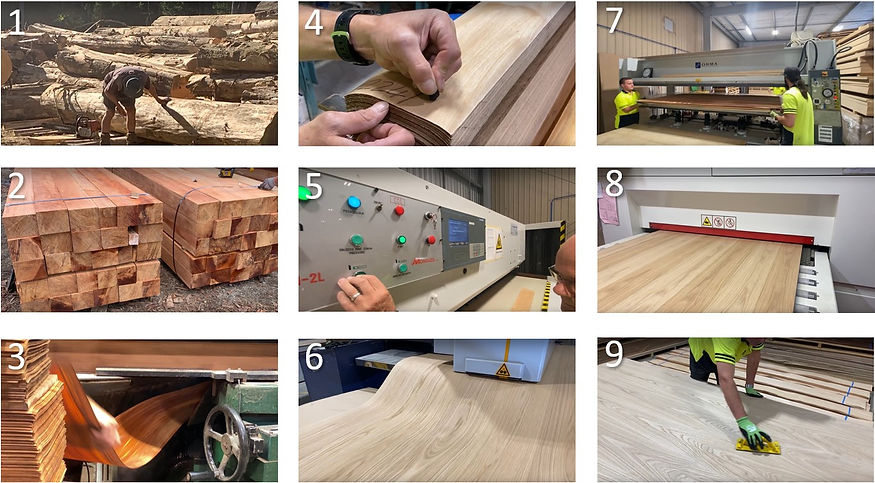
The process of producing timber veneer panels is:
-
Our selection manager works alongside forestry mills selecting the best timber, inspecting quality and ensuring paperwork is complete and compliant.
-
The timber is milled into flitches.
-
Flitches are sliced into leaves 0.6mm thick using high-precision lineal slicers.
-
The leaves are dried, graded and bundled.
-
After being trimmed to produce an extremely precise edge they are laid up in the specified matching sequence for your project.
-
Verve Veneer has two jointing machines, one specialising in exotic species and the other in native species. When leaves are joined together that sheet is called a layon.
-
The layon is adhered to the customer's chosen substrate (typically MDF or ply) and pressed under high pressure.
-
The veneer panel is trimmed to size and sanded.
-
Each sheet is given a close inspection to ensure a flawlessly beautiful veneer panel.
What different cuts are available for veneer sheets?
The most commonly used veneer cuts are Quarter cut, Crown cut, Rotary cut, Hallmark cut, and Recon cut. Each cut results in a distinctive grain pattern.
The grain patterns are created by the cut direction in relation to the grain of the tree.
-
Quarter cut is cut at right angles to the growth rings and this gives a somewhat straight line grain pattern.
-
Crown cut is cut parallel to the growth ring. The beauty of this style is its naturally sweeping curves and ovals.
-
Rotary cut veneer is peeled from the log in a continuous ribbon. This cut has a swirl grain pattern used mainly for plywood.
-
Hallmark cut results in a grain pattern very similar to crown cut however the direction of cut is along the length of the flitch, using high-precision lineal slicers for their extremely high quality.
-
Recon cut is used for reconstituted timber veneer. Recon timber is the most uniform of all wood veneers. Sustainably grown timber - usually poplar or obeche - is sliced, dyed and then glued back together in a controlled pattern. This is then re-sliced, dried and jointed to make a finished veneer layon.

This video shows a side by side comparison of veneer cuts and matching types for American White Oak.
By using the filters at https://www.veneer.co.nz/exotic-species-range you can see the difference between cuts for the Verve range of exotic species.
What is Matching, in relation to veneer?
The matching of veneer leaves determines the look of the overall layon (sheet). Each leaf is placed in a way that creates a desired aesthetic, making each panel unique. The three most common matching styles are:
-
Book Matched; this is the most common method, especially for crown cut veneer. The veneer leaves are joined in such a way as that successive leaves are turned over like pages in a book to create a mirror image, this results in a series of matching pairs across the face.
-
Slip Matched; this is often used with quarter cut leaf, especially white oak and eucalyptus. Each leaf is slipped alongside the other resulting in a series of grain repeats, the same side of the leaf is always face up, this helps when stains are being used on veneer and reduces ‘picket fencing’.
-
Mismatched/Random Matched; the terms mismatch and random match (and planked) are interchangeable. This method is commonly used to mimic solid timber; each leaf is from a different log, giving a random matched effect. Verve Veneer have a range of mismatched timber called Harmony.
The below graphic illustrates these matching methods:

What is the Milano Collection and where can it be used?
The Milano Collection is a premium range of solid-core specialty veneer doors constructed with exterior-rated materials (veneer faces bonded to exterior plywood using marine-grade glues), suitable for sheltered exterior applications as well as interior use.
Is Hallmark's timber sustainably sourced?
Hallmark's NZ native veneer comes from MPI-approved sustainably harvested timber under the NZ Forests Act, standard door timber uses sustainably sourced pine, and imported veneer timber carries PEFC, FSC, COC FSC, EcoCert, or AFS certification depending on supplier.
Sustainability & Certifications
Is Hallmark Group GreenTag certified?
Yes. Hallmark Group is New Zealand's only door manufacturer to attain GreenTag GreenRate certification, covering Solid Core Doors, Hollow Core Doors, Europa Fire & Hospital Doors, and Futura Fire & Hospital Doors, independently audited by Global GreenTag.
What Green Star / Homestar credits do Hallmark's certified doors contribute to?
Hallmark's GreenTag-certified doors contribute points to:
-
Green Star New Zealand 'Interiors NZ' (Credit 21: Sustainable Products)
-
Green Star New Zealand 'Performance NZ' (Credit 21: Procurement and Purchasing)
-
New Zealand Homestar v5.0 (EN3 Sustainable Materials)
-
EarthCheck Rating Tool
What is Hallmark's approach to waste and recycling?
Hallmark Group recovers and recycles solid wood waste and returns polystyrene waste to its supplier for recycling. Its products are made almost entirely of wood and wood-derivatives, which are readily recycled or repurposed at end of life, and Hallmark encourages customers to reuse or recycle products through construction material salvage merchants nationwide.
What is Hallmark's Broader Outcomes / CSR framework?
Hallmark's Broader Outcomes (corporate social responsibility) framework has three pillars:
-
People: diversity and inclusiveness, training, health and safety, and ethical employment principles.
-
Relationships: community involvement (such as supporting the Rapid Relief Team), educational support and customer value.
-
Sustainability: waste reduction, GreenTag certification, supply chain responsibility and certified timber.
Ordering & Practical Guidance
How do calculate the trim size for my door opening?
Hallmark provides online Trim Size Calculators for Standard Swing Doors and Pivot/Double Action Doors, with two further calculators for Cavity Sliders (Classic and CavZero) hosted on Hallmark's dedicated Cavity Slider website.
What is a left hung, or right hung, door?
Hung (or hanging) refers to which side of a door leaf the hinges are attached to. If you stand facing a closed door (on the side that opens towards you), and the knuckles of the hinges are on the left, that is a left hung door. Conversely, If you stand facing a closed door (on the side that opens towards you), and the knuckles of the hinges are on the right, that is a right hung door.

Do Hallmark doors meet New Zealand's H1 thermal envelope requirements?
Yes. Hallmark's Thermal Envelope Doors are designed to meet or exceed the R-values required under NZ Building Code clause H1/AS1 (housing and buildings up to 300m²) and H1/AS2 (buildings over 300m²), which apply to exterior doors and doors between heated and unheated areas (such as a house-to-garage door) — not standard interior doors.
Can I paint a Hallmark door and what should I know first?
Yes, but Hallmark recommends:
-
checking for transit damage or scratches in the factory UV primer before painting
-
never sanding the factory UV coating (use methylated spirits to clean it, and only 400-grit-or-finer paper if sanding is unavoidable)
-
using only Hallmark's recommended primers (e.g., Dulux Precision Maximum Strength Adhesion Primer, Resene Sureseal Water Borne Pigmented Sealer, Dulux One Step Prep Superior Multi Surface Undercoat, or oil/solvent-based primers)
-
applying lighter coat weights than older paint systems required
-
allowing sufficient drying time between coats
-
using solvent-based coatings in cold or humid conditions
See our Before You Paint information page.
Where can I find technical data sheets for Hallmark products?
Data sheets for Hallmark’s fire doors are found by filtering by brand, fire rating, type and action at the fire door data sheet page. Data sheets for Healthcare-specific doors are at the Healthcare Doors page. Hallmark's Resources page also hosts links to data sheets for every standard, fire, acoustic, hospital, and veneer door range, plus Building Product Information Requirements (BPIR), brochures, order forms, trim calculators, a paint care guide, warranty information, and installation/explainer videos.
What is a left hand, or right hand, door?
The terms Handing and Hanging are both commonly used when referring to doors in NZ, however they are easily confused. Handing generally refers to which side the handle is on, and hanging generally refers to which side the door hangs on its hinges . For both, stand facing a closed door on the side that the door would open towards you. If the handle is on the right that is a right-hand door (which means it is also left hung door), and if the handle is on the left that is a left-hand door (which means it is also a right hung door).
What is an eased door?
Eased doors have subtly sloped sides that enable a door to open and close freely. Without this the inner edge of a door leaf could strike or rub against the door jamb due to the radius of the opening arc.